Surfing the Spectacle

Gift from the Gods

Some humans are gifted with uncanny powers of healing. They literally “feel your pain” and then, remarkably, they repair all damage.

Sometimes they use psychic fusion, sometimes therapeutic touch. And sometimes, actually quite often, they use the WORD.

image

Take Rush Limbaugh, America’s most powerful radio talk show host. He knows the heart of the American soldier. He knows that American troops face troubling dangers in Iraq and Afghanistan, and that their job is most difficult.

He knows all this and he wants to help. He deeply wants to help.

If you or I could help American soldiers, we might want to get them more protective clothing, sufficiently armored vehicles, decent wages, a new president, and a safe journey home. But that’s because we don’t really understand the American soldier. Rush Limbaugh does and he knows what they want.

What they want is Rush Limbaugh. They want to listen to Rush. They want to read Rush. They want to think Rush.

image

And now for just 50 bucks, we can help them get what they want.

It’s all part of Rush’s astonishing Adopt a Soldier plan. You see, for just $49.95, you can make sure that a deserving soldier gets free online access to all of Rush’s radio archives, and gets a free subscription to his Limbaugh Letter, a colorful compendium of Rush’s wit and wisdom.

That’s an incredible offer! For instance, Rush recently explained how global warming is a socialist lie designed to destroy America, and that liberals pretend troop casualties are a big deal when there are plenty of people being murdered in American cities. Such stirring messages can really heal and invigorate our soldiers.

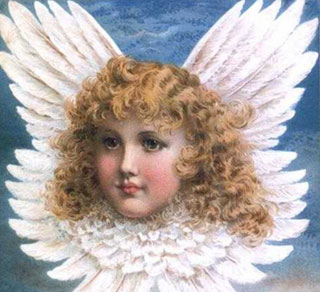
But we live in a twisted age. And we all know that there will be limp-wristed commies calling Rush a reactionary draft-dodging media-millionaire blowhard who exploits the war for his own financial gain. But why respond to the sad little spin machine of the liberals? When an angel comes bearing gifts, these monkeys can only shriek and throw their poo.
image

But is Rush the only angel truly reaching out to give our troops the very best?

Oh, no.

At FOX News, you can find another shining cherub. It’s the illustrious Bill O’Reilly who has promised that everytime you buy a copy of his book Culture Warrior – and it’s a beautiful book – he’ll send a second copy to one of the troops overseas.

That second book will be utterly free of cost.

image

That, my friends, is sincerity. That is purity of the heart. That is America at its very best.

[The war photograph was shot by Cheryl Diaz Meyer of the Dallas Morning News.]

Share 'Gift from the Gods' on Facebook Share 'Gift from the Gods' on reddit Share 'Gift from the Gods' on Twitter Share 'Gift from the Gods' on Email Share 'Gift from the Gods' on Print Friendly
1 Comment

That Which Doesn’t Exist

[A guest entry by composer and robotic sculptor Frank Garvey]

In the 20th century there have been many incidents of mindless physical attacks by deranged persons upon art masterpieces residing in churches, museums and other places of worship.

To the madman, the artwork seems to substitute symbolically, perhaps animistically, for the hated political, religious, or economic ideal he blames for his personal misery.

image

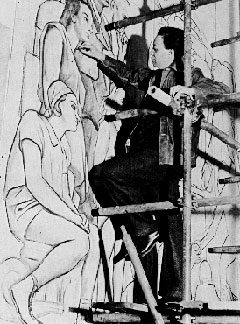
Two specific cases of this interesting transfer come to mind: one in 1934 and the other in 1972. The first was the destruction, by a madman, of progressive Mexican muralist Diego Rivera’s masterpiece in Rockefeller Center, New York City. This mural included a portrait of the communist leader Vladimir Lenin amidst depictions of the degradations produced by capitalism.

image

The second case that I wish to bring to your attention was the smashing of the face and hand of the Virgin in Michelangelo’s Pieta in St. Peters Cathedral, Rome. Some interesting conclusions about our society can be reached if we examine the fate of the two vandals. In the hammer attack on the Pieta, the perpetrator, Laszlo Toth, was diagnosed as a paranoid schizophrenic. Toth is a Maryonist, a bizarre religious sect that opposes all images in art of the Virgin Mary. He is now resting comfortably in a sanitarium. Society put him there for his own good, though there appears to be little hope of his ever recovering.

image

In the first case, the destruction of the Rivera painting, the perpetrator’s name was Nelson Rockefeller. In 1933, Rockefeller commissioned Diego Rivera to create a huge mural to grace the lobby of Radio City in the Rockefeller Center in New York. The grand theme would be “Man at the Crossroads Looking with Hope and High Vision to the Choosing of a New and Better Future.”

image

Rockefeller soon noticed, however, the images unfolding of suffering workers toiling under the regimen of capitalism. He found the stirring depiction of Lenin particularly displeasing. He demanded the head of Lenin be painted out and replaced with some other figure. Rivera rejected this “mutilation” of his work and was promptly fired. On the night of February 10th, 1934, workmen demolished the mural.

Nelson Rockefeller is a follower of a bizarre economic system called capitalism, which opposes all images of Lenin. He was appointed vice-president of the United States. He was put there for the good of his class, the billionaire class that rules the art and political world of America, and continues its imperialistic efforts to expand the empire internationally.

image

Of course it should be pointed out that, before he became vice-president, Nelson Rockefeller was already widely known as one of the 20th century’s “greatest” collectors of modern art. On lecture tours, he would often tell the story of the destruction of the Rivera mural as an amusing anecdote, noting ironically that the artist refused to speak to him for years afterward.

The writer of this essay traveled to New York to see the actual wall where the Rivera mural once resided. The information desk clerk was visibly uncomfortable when asked if the area behind him was “the wall.” He had obviously been schooled to deflect this question. He finally told me the mural never actually existed because it had never been “accepted by Mr. Rockefeller.” I realized that by that definition, I didn’t exist either.

white

In 1994 I sent one of my robots, Goboy the mechanical beggar, to the San Francisco Museum of Modern Art to see an exhibit of BLANK WHITE CANVASES by Robert Ryman. His paintings do exist; they even sell to elite collectors fortunate enough to acquire one for $500,000 or more. Goboy was soon kicked out of the museum. He was not, the guard firmly explained, a work of art.

image

[Go here for Diego Rivera’s account of the story]

Share 'That Which Doesn’t Exist' on Facebook Share 'That Which Doesn’t Exist' on reddit Share 'That Which Doesn’t Exist' on Twitter Share 'That Which Doesn’t Exist' on Email Share 'That Which Doesn’t Exist' on Print Friendly
Leave a comment

The Sporting Life

When we last looked in on the noble tradition of camel racing, we saw how some of the wealthiest men on the planet kidnapped, enslaved and brutalized the poorest of children from Sudan to Pakistan in order to use them as lightweight jockeys for their prized camels.

image

Human rights groups took issue with the tradition, and one oil-rich realm, the United Arab Emirates (UAE), tried to escape the negative publicity by banning the use of children jockeys, purchasing robotic jockeys to take the children’s place, and claiming the old tradition was all but extinguished.

Problem is, nothing beats the glory of watching a terrified child ride your camel to victory. So when the venerable custom persisted in the UAE, lawsuits were filed against certain eminent sheikhs, accusing them of kidnapping, slavery and other human rights crimes, all of which proved an awful nuisance for the illustrious gentlemen.

image

Now, finally, something good appears to be happening. Something that might actually help these kids.

The UAE has reached into its vastly deep pockets and emerged with $9 million to compensate children abused or destroyed by—ahem—the sporting life. That means helping them return to their homes, get an education, and maybe even pay their doctor bills.

Naturally the sheikhs insist their generosity is absolutely unrelated to any wrongdoing. No, they’re just looking out for the little ones who’ve lost their fine jobs with all the robots coming in. A gesture from the, um, you know…….heart.

Enough said. The nature of diplomacy. Sometimes it’s best not to scrutinize too closely why anything positive occurs. All that’s important is that global child advocacy groups such as UNICEF and the Ansar Burney Trust are down with the deal, and so shall we all be.

image

Now, perhaps someone would like to have a word with the mighty princes of Oman, just a stone’s throw away from the UAE. All the images in this entry emerged last month from this nation, where the wretched lives of child jockeys continue under the auspices of its enlightened leaders.

Share 'The Sporting Life' on Facebook Share 'The Sporting Life' on reddit Share 'The Sporting Life' on Twitter Share 'The Sporting Life' on Email Share 'The Sporting Life' on Print Friendly
Leave a comment

That Which is Subversive

One of the most subversive works in film history wears a disguise. It dresses up on Christmastime as sentimental pap, full of old cheer for the old days, sweet and safe as a Sunday sermon.

All the while it teems with despair, death, greed, corruption, brutality, prejudice, suicide, and dreams endlessly deferred.

image

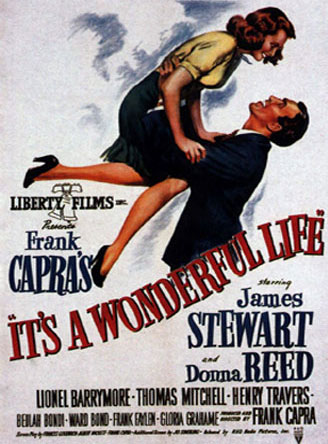
The film is It’s A Wonderful Life and much like Mark Twain’s masterful Huckleberry Finn, it can be read as quaint family entertainment or a funny, poignant and bracing cultural critique that examines the struggle to be human in an unjust world.

It’s an absolutely marvelous work of art.

What makes it subversive? It’s A Wonderful Life grew out of certain American films from the 1930s that represented unfettered capitalism as a spiritually destructive force, at odds with the deepest principles of brotherhood and social justice. Made during the depression, these films portrayed the vast gulf between the rich and the poor, and the struggle of marginalized people to maintain dignity amid a dehumanizing culture.

image

Frank Capra directed various masterpieces in this tradition (Mr. Smith Goes to Washington, Lady For a Day, Meet John Doe, etc.). But It’s A Wonderful Life came later, after WWII, and this made its message even more challenging. Hadn’t we fought a war for democracy? Wasn’t everything just fine?

Well, maybe. The studio released this film as a bundle of joy. You can see in its posters and trailers the emphasis on the glorious romance and the ceaseless joy of living. The shadows and tensions of the film were nowhere to be found in its promotion. Everything was wonderful, wonderful, wonderful.

image

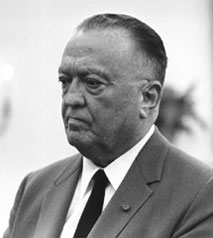
But the FBI thought otherwise. FBI Director J. Edgar Hoover investigated the film’s subversive and communistic impulses. The damning portrayal of the capitalist Potter was considered suspicious; so too the film’s depiction of George Bailey with its triumph of the common man.

Potter sees the people of the community in terms of class and ethnicity (he ridicules a lowly cab driver and calls the Italians “garlic eaters”). They’re merely “chumps,” objects ripe for financial exploitation.

Bailey sees them as human souls. The FBI’s suspicions were right on the mark.

imageimage

The radicalism of It’s A Wonderful Life springs from its humanity. As played with dizzy magnificence by Jimmy Stewart, Bailey possesses a riveting life force. We feel the power of his wanderlust, his burning desire to travel, to explore, to become anything he dares to be.

But this same openness to the universe also translates into a heightened sensitivity toward the needs of those around him. He is trapped by his own heart. To follow the ambition of his ego is to break with his secret bond to the welfare of others. This he will not do.

His actions take the shape of sacrifice. It’s not overdone – there’s no blood, no speeches, no one gets up on a cross – a price is paid, simply, quietly, continually, just below the surface of waking life. There are countless George Baileys around the world, isolated and anonymous, invisibly bending desire’s trajectory in daily deference to the life of a father, a friend, a child, a dog. It is a profoundly human experiment. It doesn’t make the magazines and it’s not on YouTube. Such people invent their own value and follow their own inner guide. They live without praise. They are utterly subversive in the face of political and economic dictates.

image

All the while, the unmet desire remains a wound that burns. Late in the film, George Bailey finds himself on a journey through the hallucinogenic night of a lost world stripped of human tenderness. Only then can he return to his own universe with eyes that can see. Suddenly the sacrifice is no longer sacrifice. The traumas no longer traumas. He walks anew through his front door with a revelation banks and business cannot possess.

Share 'That Which is Subversive' on Facebook Share 'That Which is Subversive' on reddit Share 'That Which is Subversive' on Twitter Share 'That Which is Subversive' on Email Share 'That Which is Subversive' on Print Friendly
Leave a comment

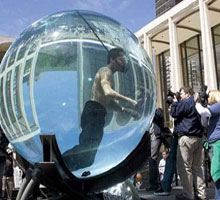
Gesture, Movement, Action

When you use a pen or a paintbrush or a pair of scissors or a computer to communicate an idea, does that tool change the meaning of that idea? What happens to the idea when the tools are removed?

image

What do we say with our bodies and our actions when we are not painting or sculpting or editing or composing? If the medium is truly the message, what do our daily gestures communicate?

imageimageimage

Are our gestures any less expressive than our art? If our actions and gestures constitute a language, why not create art based on that same language?

imageimage

At what point can we consider action as art?

image

Is the artistic experience cheapened if it’s accessible? Or does that justify its validity? Can action, the rawest form of expression, be sold or commodified like anything else?

imageimage

Does movement require a motive? What would happen if action had no rational catalyst?

image

[Guest entry by Chris Carroll with editorial assistance by SurfingtheSpectacle]

Share 'Gesture, Movement, Action' on Facebook Share 'Gesture, Movement, Action' on reddit Share 'Gesture, Movement, Action' on Twitter Share 'Gesture, Movement, Action' on Email Share 'Gesture, Movement, Action' on Print Friendly
Leave a comment

That Which is Repeated

The student has told the story before. He was in a high school history class. A topic was debated. It is 1945 and you are President Truman.

Do you drop an atom bomb on Hiroshima, Japan?

image

Do you drop the bomb? Do you drop the atom bomb on men, women and children of Hiroshima? He knew a little of the results. 80,000 dead that day. Injuries and radiation killing another 60,000. Images of burned mothers holding charred, lifeless lumps that had been their children.

image

There were arguments, of course. There are always arguments. Some historians claim that the bombing saved huge numbers of American soldiers. It was the only way to end the war quickly. The Japanese would never surrender. Most Americans were deeply relieved that it brought the war to an end.

Other historians argue that Japan no longer posed a terrible threat. They assert that the atomic bombing of Hiroshima, and the one three days later on Nagasaki, served chiefly as a warning to the next enemy on the horizon, the Russians, to back off.

image

That day in the classroom, he didn’t really know the historic truth. He doesn’t really know all of it today. But an idea began to swim in his mind. This idea: You cannot justify the extermination of innocents. You cannot justify the use of weapons that may annihilate life on the planet. You cannot.

And so he led the debate against the bombing. The history class was filled with the normal array of slackers, jocks and misfits. Few gave a damn about this subject or any other; they had their own problems. He remembers that a girl arguing for the bombing appealed to their patriotism. They were Americans, weren’t they?

image

They were. And when the vote was taken – the class always took a vote at the end of these things – his view did not prevail.

In fact, the class vote was nearly unanimous.

The bomb on Hiroshima dropped again.

[The image of the watch stopped at 8:15 and the melted Buddha come courtesy of Japanese photographer Hiromi Tsuchida. See here for more of his Hiroshima project. Check out this for strong primary sources about the dropping of the atomic bomb.]

Share 'That Which is Repeated' on Facebook Share 'That Which is Repeated' on reddit Share 'That Which is Repeated' on Twitter Share 'That Which is Repeated' on Email Share 'That Which is Repeated' on Print Friendly
Leave a comment

Behold the Light

[Guest entry by Ian Dowsett with editorial assistance by SurfingtheSpectacle]

image

Thomas Kinkade, the name alone, for anyone familiar with him, conjures up dreamy images of rustic cottages and intoxicated suburban housewives turned art collectors. His adoring fans cherish each work of the contemporary painter. But others seem to revile the man. A quick google search for “Kinkade sucks” (without quotes) offers as many as 24,800 hits. In comparison, a search for, say, “Typhoid Mary sucks” (without quotes) offers just 21,200. This proves startlingly little, yet seems very impressive.

image

Chief among the complaints concerning Thomas Kinkade is the simplistic nature of his works, typically featuring inoffensive and fanciful cottages in tranquil countrysides. Now that generally isn’t such a terrible thing; not every painter must address important and bloody social issues with a Goya-esque devotion. Yet Kinkade’s inoffensive paintings aren’t just a form of self expression or even a means to support a lifestyle. Rather they form a monstrously booming business of manufactured “Art.”

image

Kinkade’s astonishing assembly line requires scores of workers to produce the endless prints millions buy every year. They’re not paintings of course, but posters of paintings, shellacked and framed to give the illusion of a painting. And they’re huge sellers on the web, on television (he apparently sold 1-2 million dollars of his product in a single hour on QVC) and in his own line of stores nationwide. He is said to be the most collected artist in the world. And now he merchandises Thomas Kinkade cups, couches, teddy bears, and other wonderful items for the home.

image

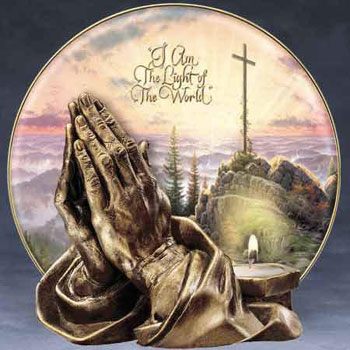
What drives the man? It’s a sacred quest. Kinkade is the “Painter of Light” (he’s trademarked that moniker, by the way). His work isn’t about business or industry; it’s a sacred thing. It’s about values. In his website, he is lovingly described as a “devout Christian who uses his gift as a vehicle to communicate and spread inherent life-affirming values.” Yes, of course. Life-affirming values.

While it’s true that he is also involved in charges of business malfeasance, sexual groping and a penchant for public urination, these trifles shouldn’t diminish his true contribution to our culture: Kinkade paints a complete and perfect picture of his audience. The public that buys his work can’t be bothered with art or the world. Such things mean nothing to them. Kinkade’s creations are monuments to the power of kitsch and manufactured art, images that can hang on a wall and affect nothing at all.

image

Now don’t misunderstand me. I adore all things tawdry and commercial. I LOVE the idea of working as an artist for a big corporation who will pay me lots of money so I can buy lots of useless crap and feed my solipsism. And yet, even to me, Kinkade is an unholy corporate devil. A capitalist juggernaut who is actually causing harm through his seemingly inoffensive “art.” A man who is celebrated, not despite having nothing to say, but because of it.

Perhaps artists do have a responsibility to society. I’m not talking about the idea of doing good and making a difference, but at least to do no harm. If such a Hippocratic Oath of Artists exists, then it’s safe to say that Thomas Kinkade pisses all over it.

image

Share 'Behold the Light' on Facebook Share 'Behold the Light' on reddit Share 'Behold the Light' on Twitter Share 'Behold the Light' on Email Share 'Behold the Light' on Print Friendly
Leave a comment

The Face of Humanity

image

On the surface of Mars, an astonishing image can be found. It is a face, ancient and mysterious, peering out into the infinite universe. Small minds imagine it nothing more than a natural land formation. But more discerning observers realize that such a spectacle could only have been created eons ago by a glorious Martian civilization.

Could we humans, here on earth, ever create a comparable monument to our own greatness?

imageimage

God knows, we’ve tried. Consider the Great Pyramids of Egypt and its marvelous Sphinx. Impressive achievements? Yes, yes, of course. But they lack a certain…something.

Let us call it majesty.

But now, mankind has finally erected our own majestic and eternal monument. And it’s all due to a noble institution that, at its own expense, hired an elite team of global scientists, engineers, architects and artists to create a sacred symbol of who we are and what we mean.

image

These artisans labored for 24 days, working around the clock to construct an awe-inspiring image comprising 65,000 exquisitely painted tiles. Once completed, another six days was needed to assemble the work in its final resting place, the mysterious Nevada desert.

The image spans a mind-boggling 87,500 square feet. It can easily be seen by any galactic visitors orbiting our planet.

Behold, one might say to them, behold the majesty, splendor and wisdom of the human race.

image

Truly, brothers and sisters, Kentucky Fried Chicken has given us all a timeless treasure.

[Guest entry by Danny Lambdin with editorial assistance by SurfingtheSpectacle]

Share 'The Face of Humanity' on Facebook Share 'The Face of Humanity' on reddit Share 'The Face of Humanity' on Twitter Share 'The Face of Humanity' on Email Share 'The Face of Humanity' on Print Friendly
Leave a comment

The Marvel of the Taser

image

Like baked bread and the polio vaccine, the taser is a glorious invention. The stun gun weapon fires 50,000 volts of electricity and, hurrah, the knife-wielding suspect is subdued. No one need fire lethal bullets and, best yet, the assailant soon feels dandy and eager to attend church. It’s totally safe and totally good.

There’s just two, you know, small problems, little things that eventually should be ironed out.

First. It kills people.

Amnesty International reports that some 500 hundred Americans have been killed shortly after being tasered. This disturbs some folks given that most victims are typically agitated but unarmed. Some are already bound. Amnesty International writes:

“They have been used against unruly schoolchildren; unarmed mentally disturbed or intoxicated individuals; suspects fleeing minor crime scenes and people who argue with police or fail to comply immediately with a command. Cases described in this report include the stunning of a 15-year-old schoolgirl in Florida, following a dispute on a bus, and a 13- year-old girl in Arizona, who threw a book in a public library…..force as last resort, instead of first.”

image

Which brings us to the second small problem. The power to inflict severe pain at the push of a button can be a temptation for certain people. They might just engage in questionable judgment.

For instance, some officers might confuse a student in a university library who is not carrying his student I.D. with, say, an armed and insane killer bent on psychopathic rampage.

The video is a bit muddy but the screams are pretty clear.

Which naturally begs the question: How can I get my own personal taser to defend myself when I go to the library?

Fortunately, there are many places; try here (“Order Online! It’s Easy!).

But also this: Look at the video and ask yourself what you would do if you happened to see someone unjustly tasered and brutalized? What exactly is the right response? Look away? Walk away? Stay and stand quietly? Take a picture? Call your friend? Scream?

Just what would you have to see before you would ACT, and what exactly would that act be?

[Don Knotts taser illustration by RJ Matson.]

Share 'The Marvel of the Taser' on Facebook Share 'The Marvel of the Taser' on reddit Share 'The Marvel of the Taser' on Twitter Share 'The Marvel of the Taser' on Email Share 'The Marvel of the Taser' on Print Friendly
1 Comment

As If We Count

image

One, two, three, four.

At some point, things change.

At some point, that which is obvious and obscene to some, becomes obvious and obscene to most.

At some point. Until then, we just count the dead. If we count them at all.

Five, six, seven, eight. American soldiers seem to die quietly. A man in Washington with his hand cupped to his ear doesn’t hear an explosion eight thousand miles away. Dead soldiers are just names we read in the newspaper.

If we read their names at all.

And Iraqi civilians? Some experts estimates 50,000 have perished since the start of this war. Others argue this number is wildly low, and that the number of civilian dead should be set closer to 150,000 or 300,000 or perhaps 600,000.

image

Who were these people?

We don’t know. We don’t want to know.

Nine, ten, eleven, twelve……

[The illustration is by Raymond Pettibon. The photo is by Lucian Read.]

Share 'As If We Count' on Facebook Share 'As If We Count' on reddit Share 'As If We Count' on Twitter Share 'As If We Count' on Email Share 'As If We Count' on Print Friendly
Leave a comment

Send in the Clowns

image

First the artist takes hair from a kitten.

Enough to make a paintbrush. Then he grinds paint pigment, he boils glue, he makes paper.

Then he paints. His work is small, a miniature, but filled with exquisite brush strokes and design and color and feeling. He is an artist in the court of one of the great Mughal emperors and he paints scenes pleasing to his royal patron.

image

Centuries later, we have Saira Wasim.

A woman. A Pakistani. An artist with no patron but her heart and her mind. She uses the old techniques of Mughal miniature to show us the new face of global politics and domination.

It is often the face of a buffoon.

image

Wasim’s work is grounded in her native Pakistan. A nuclear state where less than half of its population can read or write. A nation run by a military dictatorship and Mullahs spouting ideologies of repression. And now, a crucial ally of Uncle Sam.

She looks closely at those wielding power and depicts their world as a grand stage, a circus with clowns and missiles. In her paintings, the men who play the roles of gloried leaders frequently resemble nothing more than little boys who strike poses as the world falls beneath them.

image

Her tableaus are rich and dreamy and the tone can be comic. But there’s no mistaking that the ongoing spectacle is deadly. The cupids frequently hover like angels of death. Stars can take on the aura of cluster bombs.

Wasim knows the danger. As a woman, an artist, and as a member of a persecuted Muslim sect, the Ahmadi, Wasim had to leave her country in order to safely make this kind of work.

image
image

Princes and gods were traditionally portrayed through the Mughal miniature. So Wasim’s use of the technique endows her subjects with a disturbing kind of historical grandeur. These are the powerful ones, the paintings remind us, these are the ones that seek to command and control and consume the world.

These fools.

[Saira Wasim’s work has much more scope than I can reference here. Check out her website for a gallery of her works.]

Share 'Send in the Clowns' on Facebook Share 'Send in the Clowns' on reddit Share 'Send in the Clowns' on Twitter Share 'Send in the Clowns' on Email Share 'Send in the Clowns' on Print Friendly
Leave a comment

The Glory of Art

You’ve heard of Andy Warhol? Of course you have. Many consider him the most influential American artist of the last hundred years.

What do you make of that? What exactly is this influence? What is the function of art in our world?

image

Warhol created inventive, colorful hymns to commodity culture. He loved celebrities, currency, and other popular objects and icons. He embodied the society of the surface in all its splendor.

And attention was paid. His work is extremely valuable.

image

You’ve heard of Ronnie Stuiver? Of course you haven’t. He’s a South African engineer. He doesn’t have a television show or a press agent. Some years back, he traveled around rural South Africa drilling holes in the ground for new water wells.

This is important work. People on this planet die everyday because they can’t find clean water. In rural South Africa, millions of lives are in jeopardy. There simply are not enough water wells and not enough uncontaminated pumps. And even when the wells and pumps are in place, getting the water can be extremely burdensome. Hand pumps take a great deal of effort and the wells are often located miles away from home. It falls mostly to women and girls to pump the water and haul it home in heavy buckets. It’s time-consuming labor and exhausting.

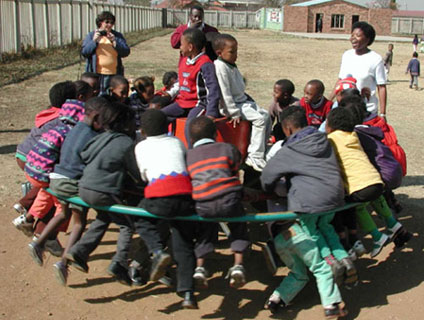
Back to Ronnie Stuiver. When he went around drilling new wells, village kids would crowd around and watch him. These kids didn’t have much and they didn’t have much to do. He wanted to give them something. One day he came up with an idea. A very good idea. He would make something that they could play with — and that could rapidly pump water at the same time.

A merry-go-round.

image

As the children spin and spin and spin, clean, safe drinking water rises from a deep borehole.

His idea wasn’t art, no, no, it wasn’t art. It was merely a creative idea that transformed reality, improved it, opened it up.

You’ve heard of Trevor Field? Of course you haven’t. He was an advertising executive, one of those clever men who have a talent for creating desire, selling a dream, making a buck. He happened to see Stuiver’s merry-go-round attached to a water pump, and he got an idea. A good one. The best one of his life.

He imagined a merry-go-round linked to a pump head, a water tap stand, and a storage tank. He imagined water towers as makeshift billboards, two billboards bringing in advertising revenue to pay for the pump’s upkeep, two others publicizing AIDS education. And he imagined this “playpump” system springing up everywhere it’s needed in South Africa.

image

But it’s not art, he hasn’t made art. No. He merely conjured a series of inspired ideas that sought to transform everyday life for poor, rural South Africans.

Now through the collaborative efforts of many people, his idea has been put into motion. And it works. Children love the things. Their play reduces the toil on their mothers. And the water is fresh and clean. More than 700 of these merry-go-round pumps have been installed throughout South Africa and it’s quickly expanding to neighboring countries.

image

The price to install one of these playpumps in a rural village? Seven thousand dollars.

That Andy Warhol painting of Marilyn Monroe at the top of this entry?

An art lover purchased it for $17 million.

You tell me which aesthetic seems more compelling, which creation appears more powerful.

Share 'The Glory of Art' on Facebook Share 'The Glory of Art' on reddit Share 'The Glory of Art' on Twitter Share 'The Glory of Art' on Email Share 'The Glory of Art' on Print Friendly
Leave a comment

Children’s Guide to Terrorism

It’s a dangerous world for kids out there today. I think we all know that. But what can we do about it?

One fine man has found an answer. He’s the beloved and world-renown children’s illustrator and author Archibald P. Campbell. The marvelous Archie (as his fans and pals call him) has created a wonderful new work that speaks directly to the little ones, gently instructing them about the Arabian peril that threatens their every breath.

The book is slated for release in spring of 2007. But we’ve been graciously permitted an early peek at the cover and the first two pages. What a delight!

image

There’s a tenderness to all his books. Never more so than in this one.

image

But with the tenderness, naturally, there must be everlasting fear and danger.

image

Archie has already won a Pulitzer Prize for his writing and a Caldecott Medal for his illustrations. But he’s told us that a work like this isn’t about awards or fame or money, it’s about extending a helping hand to America’s kids, showing them the true face of menace in their lives.

And, for this, we are truly grateful.

Share 'Children’s Guide to Terrorism' on Facebook Share 'Children’s Guide to Terrorism' on reddit Share 'Children’s Guide to Terrorism' on Twitter Share 'Children’s Guide to Terrorism' on Email Share 'Children’s Guide to Terrorism' on Print Friendly
Leave a comment